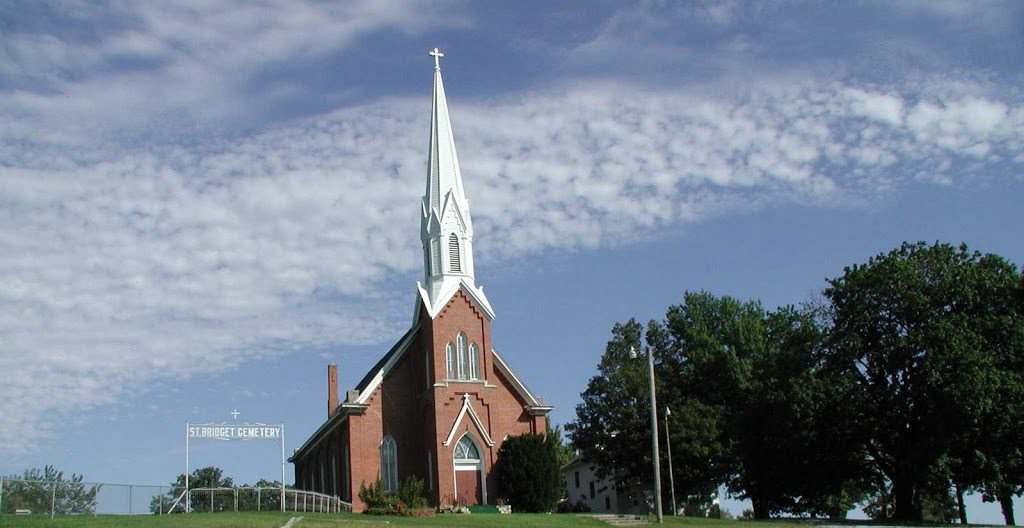
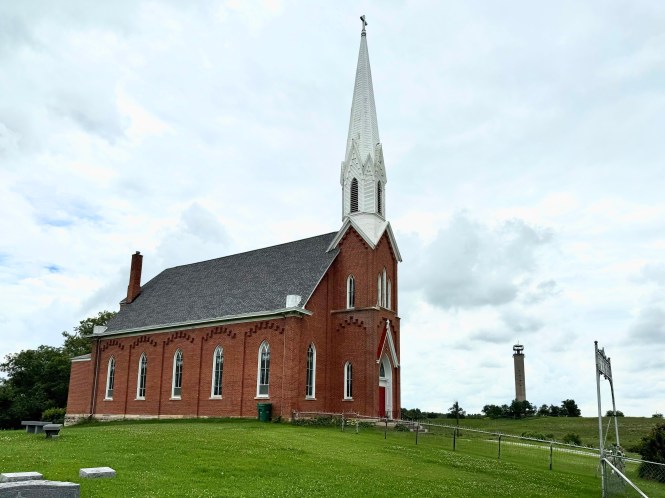
If you grew up around here and attended St. Bridget’s Church, then you have driven by this tower hundreds of times. Often to the point where you hardly even notice it standing there. Occasionally, you would wonder about that tall, narrow, concrete building as you went by it on your way to church. Most of us would just assume it was some kind of radio tower with lights on the top to warn airplanes of its presence.
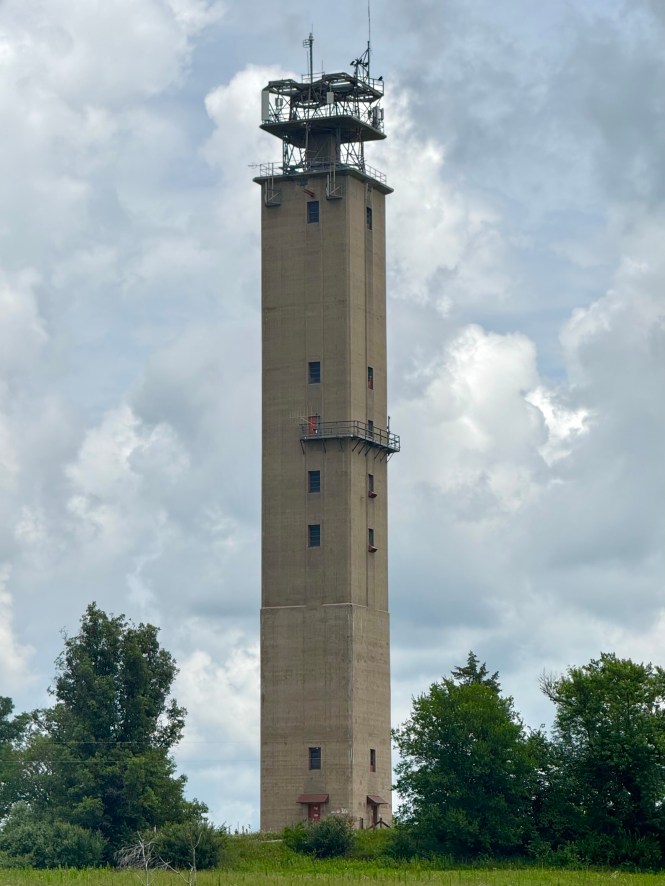
The tower has always been a welcoming landmark that you could see for miles away when driving the beautiful, winding country roads to St. Bridget’s Church. It is often used as part of directions for those unfamiliar with the church’s location. “You will see a large tower, and the church is beside that.” But rarely does anyone describe or even know what that tower is, and it just sits unknown and unmarked in the nearby field.
Tim O’Neil, longtime resident and member of St. Bridget’s Church, shed some light on the origin and purpose of the tower. Tim worked for the Iowa City phone company for 42 ½ years and knew the story behind the tower.
He said that it was part of the AT&T/Long Line telephone microwave towers used to relay phone calls. He remembers climbing to the top of the almost identical tower located near Homestead/Amana and being at the top and seeing the faint outline of the St. Bridget’s tower 32 miles away.
The AT&T Long Lines network featured a system of microwave relay towers that transmitted information across the United States. Built in the early 1950s, the towers were a line-of-sight network that conveyed analog data such as phone conversations and television signals. The towers were spaced 30 to 40 miles apart using zig-zag patterns to avoid signal overlap. It was the largest network of its kind when it opened, and unique in that it relied on microwaves rather than above-ground transmission wires.
Throughout the early days of telephone and telegraph systems, wired systems were the only option. Long lines of cable connected cities together, although this system presented major issues. The first was vulnerability. Much like power lines and present above-ground cable systems, a tree limb or storm could easily knock down the cables. This isn’t a major problem when ten or twenty people are affected, but when hundreds of thousands of people are affected, as well as vital operations, it could be catastrophic. The second issue is that wired systems were expensive to set up and required lots of maintenance. Miles and miles of thick cable were expensive and difficult to install and repair when damaged.
The first coast-to-coast telephone call was made on August 17, 1951, using the Long Lines – sometimes known as “Skyway” or “Telephone Skyway” network. The stations were connected via line-of-sight horn antennas, which transmitted and received microwave signals. A phone call placed in one part of the country would be passed on to the next relay station, then passed on to the next, and so on until it reached the station nearest its destination. Then it would be sent through cables to the telephone company, then to your house. Each antenna was positioned so that it made a direct line-of-sight path to the next station. The towers were not only used to relay the transmission of telephone data, but also television shows. NBC, CBS, and other networks used this to air their shows and news networks all around the country.
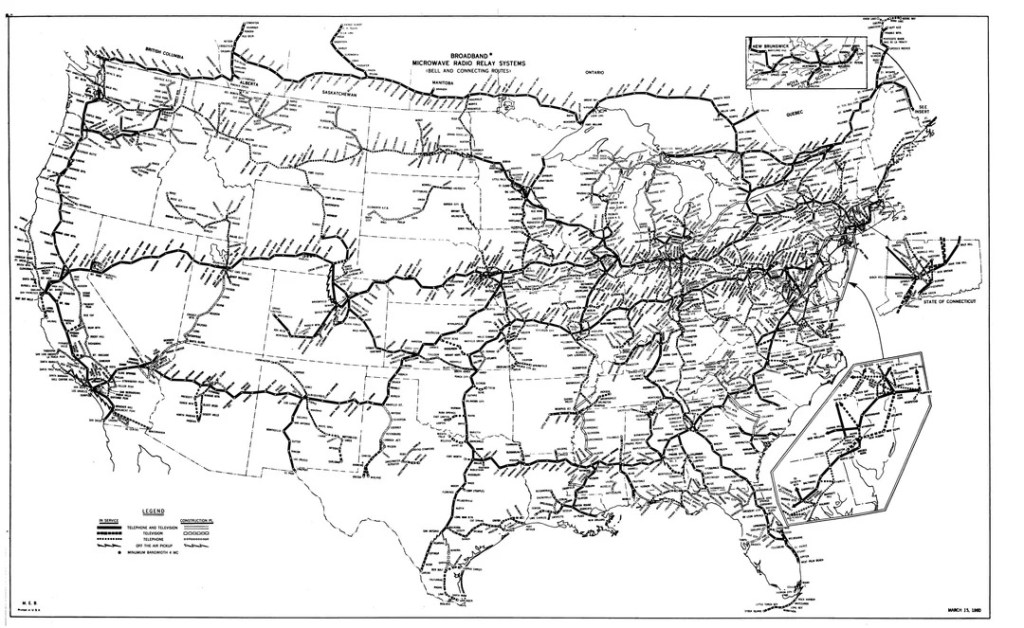
Between 1946 and 1991, the United States and the Soviet Union were locked in a long, tense conflict known as the Cold War. It was called that because both sides were afraid of fighting each other directly for fear of a nuclear war, so it was done indirectly by other means. During the height of the Cold War, the importance of the Long Line towers grew. Military phone calls and data were transmitted through the towers.
Many towers had their base stations installed underground in shielded rooms that were tested to withstand a nuclear blast. Some underground stations were also equipped with the same toiletries, survival kits, and items that many fallout shelters had. Others were outfitted simply to survive the blast waves of nuclear weaponry with no need for human staff.
The towers themselves were also designed to withstand a nuclear detonation and had diesel backup generators. Some above-ground stations were also designed with sophisticated systems to keep the network online in the event of an attack. As the Cold War heated up, the United States government took great interest in the defensive benefits that a communications network would provide. Physical wires on poles could easily be cut by enemy ground forces, let alone totally destroyed by the new weapons of the era: atomic and nuclear weaponry. Microwave relay systems resolved that problem, as all you needed were a few working towers to transmit and receive signals.
During the 1970s, technology breakthroughs eventually spelled the end for the Long Lines system. One of the new innovations was the use of fiber optics. Fiber optic lines are typically located underground, eliminating the vulnerabilities of earlier systems. The second innovation was the use of satellites themselves. Television programs could be relayed using satellites that orbited in our upper atmosphere, which allowed for widespread and nearly instantaneous relays that required minimal equipment. And since the relaying equipment wasn’t on the ground in the middle of a cornfield, it was less prone to damaging storms and vandalism. Fiber optics and satellite systems quickly became the norm, replacing the Long Lines system. By the early 1990s, AT&T decided the system had served a long, faithful life, and it was time to stick a nail in the coffin. The horn antennas were removed or replaced, and just like that, the Long Lines system faded from being state-of-the-art technology to just abandoned towers and buildings.
Tim O’Neil remembers hearing the story that various companies put in their bids to tear down the existing, unused towers across the country. Due to the size and strength of the towers, those companies later went bankrupt because of the cost to dismantle them. Many of the Long Line towers remain as a reminder of how far we’ve come in the world of communication. We went from having telephone party lines and talking to phone operators to now having handheld phones and computers. We don’t need to stand by the telephone to make a call or wait for one now; we can do it all from virtually anywhere. As for the towers themselves, some have been reduced to scrap, and others have been repurposed for cell phone towers, ham radio antennas, or other uses. But many just sit abandoned since the early 1990s.
The tower by St. Bridget’s Church sits quietly nearby in the field and can remind you of its amazing history and the system that was once part of the first lines of defense during the Cold War. But for most of us, it is just a familiar landmark with the important purpose of guiding us through the countryside to the beautiful and peaceful St. Bridget’s Church and cemetery.
(Information here is from personal information obtained and numerous internet articles- compiled by Leanne O’Neil Rathjen)














 Friends of St. Bridget's Church